

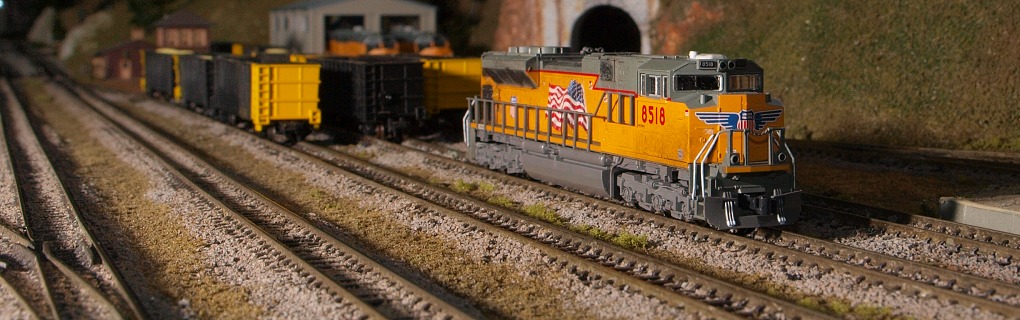
The Battle River Railway, a farmer-owned railroad in central Alberta, has begun moving wheat in partnership with Canadian National.
Battle River Railway has been operating a former CN branch line between Camrose and Alliance since 2010. The railroad regularly moves grain, stores cars, and offers occasional excursions. Earlier this year, the railroad partnered with Westlock Terminals, Ltd., the Port of Westlock, and CN to do a test run of five cars of wheat. Wheat was previously moved by truck 140 miles from an elevator in Rosalind to the terminal in Westlock. But with the purchase of a wheat unloader, it can now go via rail. The inaugural five-car move over Battle River took 11 truckloads off local highways.
The railroad anticipates moving about five cars of wheat per month. General Manager Matthew Enright told Progressive Railroading that the new traffic is a win for the railroad, its shippers, and the community.
“When local organizations work together with shared values and community-driven goals, they create lasting opportunities that benefit farmers, rural economies and the future of agriculture in Alberta,” he said.
—Justin Franz
The post Alberta Short Line Scores New Wheat Move appeared first on Railfan & Railroad Magazine.
“We’re proud to have been on the recruitment team for this project and look forward to helping SODECIA AAPICO serve our joint customer, Scout Motors,” saidGVP Industrial Development Craig Hudson.“This investment strengthens the growing automotive supply chain taking shape across South Carolina, and we’re grateful to have strong partnerships with state and local economic development leaders – like the Orangeburg County Economic Development Commission – to bring these quality projects to life.”
Why it MattersAccess to an NS rail-ready site made the location a top contender for advanced automotive manufacturing.
Customers are celebrating the announcement:
“We are thrilled to take this important step toward expanding our footprint in the United States. With our joint resources and the strong confidence that Scout Motors has placed in both companies, success is our only goal.” -AAPICO CEO Mr. Swee Chuan Yeap
“This project symbolizes the strength of collaboration. By combining the best of both companies, we are creating a world-class facility that will deliver value to our customer and long-term opportunities for the local community.”-SODECIA CEO Mr. Rui Monteiro
“This announcement marks another important milestone as we work to build a robust, local supply chain for Scout Motors and create meaningful opportunities for South Carolinians. By investing in Orangeburg County, the Sodecia Aapico joint venture is bringing hundreds of new local jobs, strengthening this state’s thriving automotive ecosystem, and reinforcing our shared commitment to making high-quality Scout vehicles right here in South Carolina. We’re grateful to our partners and to the community for embracing our vision of growth and opportunity.” -Scout Motors President and CEO Scott Keogh
State and industry leaders also welcomed the investment:
“Today’s announcement by Sodecia Aapico JV is another clear vote of confidence in South Carolina’s world-class workforce, and it will further strengthen our booming automotive industry. This announcement is also the latest example of Scout Motors’ arrival driving additional investment and job creation across our state, bringing even more opportunities and prosperity for our people.” -Gov. Henry McMaster
Norfolk Southern’s rail network and site development expertise helped secure this investment for South Carolina – fueling job creation, strengthening the automotive ecosystem, and supporting Scout Motors’ long-term success.
Learn more about how Norfolk Southern supports site selection and industrial growth here.
Katie Byrd leads external communications for Norfolk Southern in the areas of Executive Comms, Commercial and Strategic Planning. She joined NS in 2022, bringing nearly 10 years of strategic communications expertise.
The post NS-Served REDI Site Attracts New Automotive Supplier in South Carolina appeared first on Railway Age.
The scope of the audit (download below) includes Metrorail’s communications systems (voice or data transmission systems and related equipment) presently in use or available for use (e.g. back-up systems). This includes radio and public address (PA) systems. The audit’s objectives include the assessment of communications systems inspections, maintenance, engineering, operational practices and procedures, and associated training for purposes of compliance with applicable Metrorail plans and procedures, regulations, and best practices.
The audit also focused on Metrorail corrective action plans including Metrorail’s Quality Assurance, Internal Compliance & Oversight (Quality) internal audits and corrective action plans, WMSC corrective action plans, and WMATA recommended corrective actions that are overseen by the WMSC along with review of any related safety event investigations involving Metrorail’s communication systems.
The audit identified critical areas where Metrorail does not follow its procedures and requirements. There are four findings that Metrorail is required to address through the corrective action process, as well as one existing corrective action plan (C-0219) that required modification. There are additionally two recommendations for Metrorail’s consideration. The findings and recommendations identified are:
Findings
Recommendations
Metrorail is required to propose corrective action plans to address each finding no later than 30 days after the issuance of the report.
2025.12.04-WMSC-Communication-Systems-Audit-Report-Final-protectedDownloadThe post WMSC Issues Safety Audit of WMATA Communication Systems appeared first on Railway Age.
NMT invested approximately $1.4 million to update the northern portion of the line, according to a Dec. 4 report by Sunport, New Mexico’s largest commercial airport, which is owned and operated by the City of Albuquerque’s Aviation Department. The move will allow NMT to store and handle more railcars, and the company is expected to begin paying per-car fees to Sunport in early 2026, creating a new revenue stream for the airport’s enterprise fund.
Sunport purchased the entire line in 2022 and said that combined with the nearly 400 acres it acquired in September 2025, gives it ownership of nearly 1,000 acres of undeveloped property for future economic development.
“The line was constructed for and owned by the Atomic Energy Commission to serve Sandia National Laboratory, a facility established as part of the Manhattan Project headquartered out of Los Alamos, N.Mex., during World War II,” Sunport said. “Ownership of the line transferred to Kirtland Air Force Base when Sandia was merged into Kirtland in the 1970s. The line was operated under an O&M agreement with the Santa Fe Railroad (which later became BNSF) for many years until Kirtland’s and Sandia’s mission evolved from its legacy focus on atomic research and development and the spur was no longer needed for regular use. The spur sat idle until the base decided it would not be needed for future missions and put it up for auction in 2021, when it was purchased by Sunport.”
The spur (see map, top) begins at Broadway on the main rail line and loops around I-25 through the southern edge of Sunport property, which Sunport said is suitable for large-scale industrial and logistics operations. Key industries and activities have already identified as strong opportunities for the site, it said, including industry clusters in research, applied sciences, and media and entertainment.
According to KRQE of Albuquerque, NMT took about six months to rehab the 1.5 miles of rail spur, which is expected begin operations next month.
Additional assessments are under way to rehabilitate the remainder of the line, according to Sunport, which told the media outlet that it is “working on finalizing funding to activate the remaining 2.5 miles of spur,” with work anticipated to begin by year-end 2026.
“By bringing rail, air service, and foreign trade zone benefits together in one location, we’re creating a powerful hub for business,” City of Albuquerque Economic Development Director Max Gruner said. “This partnership with NMT will help attract new companies, support local jobs, and strengthen Albuquerque’s economy.”
“No other site in New Mexico has the right geography, infrastructure, and proximity to airfield operations to support an integrated multimodal system like the one we envision,” City of Albuquerque Aviation Acting Director Manny Manriquez added. “This is a true regional economic development to realize our unfolding vision for logistics and related land-side developments to transform the Sunport into an even larger economic engine for the region.”
“The public-private partnership that has been formed with NMT is a perfect symbiotic relationship for the continued business and economic growth of our city and state,” NMT Director of Business Development Brian Connell noted. “We’re glad for the chance to provide our established customers more opportunities to ship and receive interstate and international commodities.”
“With the opening of this first segment of track, we can immediately bring positive impact to local businesses,” Albuquerque Mayor Tim Keller concluded.
The post Sunport Reactivates Albuquerque Rail Spur appeared first on Railway Age.
Inside the December 2025 issue, you’ll also find features covering:
And don’t miss commentary by:
The post Railway Age December 2025 Digital Edition Now On Line appeared first on Railway Age.
The New York MTA on Dec. 2 unveiled a first-of-its-kind, limited-edition merchandise collaboration with the AMNH in celebration of the 40th anniversary of MTA Arts & Design. The capsule collection draws inspiration from artwork at the 81st Street-Museum of Natural History B and C subway station.
The station’s expansive mixed-media art installation, titled “For Want of a Nail,” compromises glass mosaic, glass tile, ceramic tile, granite, and bronze relief. It was developed by MTA Arts & Design in partnership with AMNH staff and community members and installed in 2000. The designs, the agency says, “reflect the broad scope of the Museum’s renowned collections and exhibitions, celebrating the intersection of science, art, and the everyday journeys of transit riders.”
The collection apparel and accessories for all ages—adult and children’s t-shirts, a fleece sweatshirt, water bottle, tote, backpack, hat, stickers, magnets and collectible pins. Merchandise is available exclusively at the AMNH Gift Shop and online store while supplies last.
This initiative, the agency says, “reflects the MTA’s ongoing commitment to enriching the transit experience through art, culture and community partnerships. It also invites New Yorkers and visitors alike to engage with public transit and natural history in a new and tangible way. The collaboration is part of a broader initiative to generate incremental revenue for the MTA through activities such as licensing and advertising.”
“Transit’s not just a way to get from point A to point B, it’s a cultural experience,” said MTA Chair and CEO Janno Lieber. “Few stations make the point better than 81 St–Museum of Natural History with its stunning mosaics, and we hope this will be the first of many location-based collections between the MTA and iconic New York institutions like this one.”
“Most of our visitors and staff arrive at the Museum by subway through one of the most iconic and beautiful stations in the system,” said American Museum of Natural History President Sean M. Decatur. “A journey of discovery begins the minute you step off the train and encounter spectacular art installations that reflect the wide range of the Museum’s scientific work and exhibitions, thanks to Arts for Transit and our longstanding partnership with the MTA. We’re delighted now to build on our partnership, enabling visitors to bring home a souvenir both of their time at the Museum and their travel through the 81 St–Museum of Natural History station.”
VIA RailVIA Rail on Dec. 3 welcomed elected officials, partners, and members of its Accessibility Advisory Committee to its Ottawa Station to mark the International Day of Persons with Disabilities and to unveil its 2026-2029 Accessibility Plan, recently submitted to the Government of Canada.
For VIA Rail, the agency says, “accessibility is not simply a goal, it is a core value that guides its decisions, the design of its services, and the way its teams welcome and support passengers and employees.” For several years, it has worked closely with experts, specialized organizations, and persons with disabilities to make its network, digital tools, and workplace increasingly inclusive.
“As Canada’s national intercity passenger rail carrier, we have a responsibility to make transportation accessible to as many people as possible,” said VIA Rail President and CEO Mario Péloquin. “With unprecedented federal support and the guidance of our accessibility partners, we are delivering a travel experience that removes barriers and expands mobility for all Canadians.”
The 2026–2029 Accessibility Plan (download below), VIA Rail says, reflects this ambition and is structured around strengthened priorities, including:
The event also highlighted the crucial role of collaboration. Organizations such as Transport Canada, Ottawa Tourism, members of VIA Rail’s Accessibility Advisory Committee, and participants in the various accessibility consultations have, for years, helped shape the solutions being implemented, the agency noted.
The plan is also supported by federal investments, including those announced in Budget 2024 to renew VIA Rail’s pan-Canadian fleet, which will introduce modern and universally accessible trains across the country beginning in 2032.
2026-2029_VIA-RAIL_Accessibility-Plan_ENDownload Mass. GovernmentMassachusetts Governor Maura Healey on Dec. 3 held a signing ceremony for a bill to protect transit workers from assault and battery, according to a WWLP news report.
According to the report, the new law “ensures public transportation workers are explicitly protected from assault and battery, including assault involving human secretions. The human secretion clause closes a loophole in the law where certain behaviors did not previously explicitly fall under the categories of assault and battery. According to the governor, transit workers often face violent behavior from customers while working.”
The protections, WWLP reports, which, applies to transit workers across the state—Massachusetts Bay Transportation Authority (MBTA) employees in Cambridge to bus drivers in Chicopee—takes effect in early March, 90 days after the official signing.
The post Transit Briefs: NYMTA, VIA Rail, Mass. Government appeared first on Railway Age.
Democrat Robert E. Primus, fired Aug. 27 from the Surface Transportation Board (STB) by Republican POTUS 47, alleges in an amended legal challenge filed in federal district court Dec. 4 that the primary reason for his termination is racial discrimination—not politics nor concerns how he might vote on the soon-to-be filed merger application by railroads Union Pacific (UP) and Norfolk Southern (NS). Primus seeks reinstatement.
When terminated in August, Primus was in the midst of a second Senate-confirmed five-year term expiring Dec. 31, 2027.
Primus’ first term began in January 2021 following nomination by POTUS 45. He was filling a seat left vacant by Democrat Deb Miller, whose term expired in 2018. Democratic President Joe Biden designated Primus as chairperson in 2024, following the retirement of Democratic Chairperson Martin J. Oberman. After taking office in January 2025, POTUS 47 designated sitting Republican board member Patrick J. Fuchs as chairperson, with Primus returning to member status—a typical event when Presidential Administrations change.
Of 117 White House nominated and Senate confirmed members of the 138-year-old STB and its Interstate Commerce Commission (ICC) predecessor, Primus is only the fifth Black, and was the first Black chairperson. Prior to Primus’ Senate confirmation, it was 2001 when the STB previously had a Black member—William Clyburn Jr., who departed upon term expiration.
Primus first challenged his firing in September in federal district court as unlawful, alleging members of independent regulatory agencies may be removed only for cause (inefficiency, neglect of duty or malfeasance in office), and that POTUS 47 failed to provide a valid reason. Primus’ “effective immediately” termination was made in a terse 28-word email from the White House Personnel Office.
In his Dec. 4 amended complaint (download below), Primus says his firing “fits within a pattern of the Trump Administration disproportionately removing Black government officials, and particularly Presidentially appointed and Senate-confirmed Board members of independent multimember agencies.” He says “75% of Black federal officials” on multi-member agencies have been removed from office. In contrast, Primus says “only approximately 27% of white federal officials” on multimember agencies have been removed.
The amended lawsuit asserts that the Constitution’s Fifth Amendment Due Process Clause “guarantees the federal government will provide all people with equal protection under the law. Included within the ambit of these rights is a protection [because of race] against discrimination in employment decisions.”
Additionally, the amended complaint rejects that Primus’ political affiliation as a Democrat could be “the sole reason” for his termination, as even had Primus remained a Board member, a third Republican vacancy exists to assure a 3-2 Republican majority. That allegation is questionable, as if Primus had remained, and the third Republican seat not filled, the Board would have two Republicans and two Democrats. The amended complaint further says that while Democrat Primus, a Black, was removed, Democrat Karen J. Hedlund, White, retained her seat.
Hedlund is serving her first term, which expires at the end of December and is eligible for a second five-year term, although no renomination has been made. Primus, as mentioned, was in his second term, with a Dec. 31, 2027, expiration. By statute, STB members may remain in holdover statute up to 12 months beyond term expiration or until a successor has been Senate confirmed.
Primus is represented by Democracy First Foundation (a national legal organization that “advances democracy and social progress through litigation, policy, public education, and regulatory engagement”) and Justice Legal Strategies (a civil rights law firm). The lawsuit is against POTUS 47 and Fuchs, in his official position as STB chairperson.
Primus is not the only Black fired by POTUS 47 from an independent federal regulatory agency. Other Blacks fired have been Democrat Rebecca Slaughter from the Federal Trade Commission; Democrat Gwynee Wilcox from the National Labor Relations Board; and Democrat Alvin Brown from the National Transportation Safety Board. Each has filed a lawsuit alleging unlawful termination. Brown amended his Dec. 4 to make the same racial discrimination allegation as Primus.
Because of first-impression Constitutional questions, finality for each of the original lawsuits must await Supreme Court review. The Justice Department, which supports the firings, argued that even if the POTUS 47 terminations are unlawful, courts have no authority to order reinstatement.
Democrat Deidre Hamilton, fired by POTUS 47 from the National Mediation Board, has so far not filed a lawsuit. She does not identify as Black.
Primus is not without a contentious history on an agency whose reputation depends on perceptions of decisional independence, free from influence of special interests or politics. Throughout his time at the STB, Primus displayed an alignment with rail labor on issues over which the STB has no jurisdiction—carrier employment levels and implementation of operating strategies such as Precision Scheduled Railroading. In a personal appearance at a rail labor union event, Primus said, “Thank you for letting me represent you”—a suggestion perceived by many as in conflict with impartial execution of STB responsibilities.
There have been unvalidated allegations that Primus was predetermined to vote against a UP-NS merger based on his opposition to a 2022 STB-approved merger of railroads Canadian Pacific with Kansas City Southern to form CPKC. Those allegations gained traction following a recent meeting between UP CEO Jim Vena and POTUS 47 at which Vena made a cash contribution on behalf of UP to a POTUS 47 planned White House ballroom, and the President responded how the proposed merger “sounds good to me.” There is no evidence that Primus’ firing—which occurred months before the Vena-POTUS 47 meeting—was urged by Vena or UP lobbyists.
The five-member STB is currently at a strength of three—Republicans Fuchs and Michelle A. Schutz, and Democrat Hedlund. Schultz, whose first term expires in late 2026, was renominated to a second five year term by POTUS 47 and awaits Senate confirmation. POTUS 47 nomination of a third Republican, Richard Kloster, is currently before the Senate Commerce Committee, which will meet in Executive Session Dec. 8 to vote on whether to recommend him for Senate floor confirmation. The STB’s second Democratic seat, held by Primus until his termination, remains open.
It was not until 1979 that the ICC and its STB successor (the ICC created in 1887) had its first Black member, Marcus Alexis (1979-1981), who was nominated by President Jimmy Carter. Other Blacks, in addition to Primus, were Reginald E. Gilliam Jr. (1980-1983), Jacob J. Simmons (1982-1983 and 1984-1986), and Clyburn (1998-2001).
The first female ICC/STB member was Virginia Mae Brown (1964-1979), nominated by President Lyndon Johnson. Since, there have been nine other female members: Betty Jo Christian (1976-1979), Heather J. Gradison (1982-1990), Karen B. Phillips (1988-1994), Gail C. McDonald (1990-1995), Linda J. Morgan (1994-2003), Ann D. Begeman (2011-2021), Debra L. Miller (2014-2018), Michelle A. Schultz (2021-____) and Karen J. Hedlund (2021-____).
The ICC/STB has had only one Latino member, Democrat Rodolfo Montejano, a Mexican American attorney son of a migrant farm worker, who failed to gain Senate confirmation but received a recess appointment from President Richard Nixon in 1972. Four months later, Montejano voluntarily resigned to make way for another Nixon nominee, Democrat A. Daniel O’Neal.
Railway Age Capitol Hill Contributing Editor Frank N. Wilner, a former White House appointed STB chief of staff, is author of “Railroads & Economic Regulation,” which includes a history of the ICC and STB, including significant decisions and biographies of the agency’s 117 members. It is available Simmons-Boardman Books, 800-228-9670.
Primus-v-Trump-amended-complaintDownloadThe post Primus, Late of STB, Alleges Racial Bias appeared first on Railway Age.
The budget, which runs from Jan. 1 to Dec. 31, 2026, aligns expenses with the transit agency’s Strategic Plan, minimizes impacts to transit service delivery, and retains the people needed to “deliver its mission,” according to RTD, which provides light rail, commuter rail, bus, on-demand, paratransit, airport, and special event services in eight Colorado counties. The budget proposal was made available for public inspection in October.
(Courtesy of RTD)Excluding the impact and timing of the $138 million East Colfax Bus Rapid Transit (BRT) project, RTD said its revenue budget is expected to increase 6% to $1.141 million over the 2025 budget. The agency’s labor and purchased transportation expense comprise 60% of operating expense in next year’s budget.
RTD’s primary source of revenue—69% in the approved 2026 budget—comes from the collection of a 1% sales and use tax in the Denver metro area. “The sales and use tax is subject to external market factors, including inflation, recessions, and the availability of goods and services,” RTD noted. “The budget also accounts for uncertainties in the financial climate for government agencies and private businesses alike.”
The Business Research Division (BRD) of the University of Colorado Boulder’s Leeds School of Business conducted independent third-party research to provide semi-annual sales and use tax forecast models to RTD in September 2025, according to the transit agency. The BRD projected a 1% increase in sales and use tax revenue in 2026, with a forecast of $877 million vs. its latest forecast for 2025; the $877 million in 2026 is 3% lower than the 2025 budget, as BRD’s projections for 2025 declined since RTD adopted the 2025 budget in November 2024, the transit agency said. For 2026, this revenue amount is forecasted to comprise 77% of RTD’s expected funding sources before the impact of East Colfax BRT, it said. BRD’s medium forecast financial models are used by RTD to develop its annual budget and five-year financial forecast.
RTD said it plans to “pare back funding for service contracts in 2026 that did not meet the anticipated budget costs for 2025,” resulting in a projected $17 million savings. The agency’s closed (legacy) pension plan contribution for salaried employees is budgeted at $7 million in 2026 vs. $15 million in 2025, because, RTD said, “the plan is considered adequately funded.” Another budget reduction is the delayed hiring for 81 vacant positions to yield $7 million in savings, and modifications to overtime are projected to deliver savings of $5 million, the agency reported.
While RTD plans no reduction in force for 2026 in the budget, it excludes an allotment for a cost-of-living adjustment or merit increases for non-represented employees. The agency noted that in October 2025 it implemented a cost-saving measure impacting non-represented RTD employees who received a merit increase as a one-time lump sum distribution in 2025 that resulted in $4 million in savings for 2026.
(Courtesy of RTD)The RTD Board amended the 2026 budget to exclude $20 million in debt financing for cutaway vehicles used for paratransit and FlexRide services, according to the transit agency. The plan includes prepayment of $57 million in 2026 debt obligations “to strengthen the agency’s fiscal performance,” it noted. The approved 2026 budget includes no change to the FasTracks Internal Savings Account balance, which RTD said is currently $192 million. The capital replacement fund is proposed at $166 million, though RTD said it is “not expected to be sufficient to cover capital requirements through 2030.” The operating reserve of $227 million is set at three months of operating expenses according to fiscal policy, it noted.
Debra A. Johnson (Courtesy of RTD)RTD said it will monitor expenditures throughout 2026 to identify further savings opportunities, while avoiding actions that would postpone funding for preventative maintenance or equipment replacement. Additionally, it said the Board “will continue to incorporate a budgetary monitoring system that charges expenditures against approved appropriations.”
RTD’s FY 2026 budget complies with Colorado Local Government Budget Law.
“The 2026 budget includes an overview of cost-saving recommendations to more closely align expenditures to projected revenue,” RTD General Manager and CEO Debra A. Johnson said. “RTD will take a disciplined approach to managing expenses in the year ahead, and the agency is proposing implementation of a variety of opportunities that reduce costs and ensures good fiscal stewardship.”
In related news, RTD earlier this month released its third-quarter financial results for FY25. While total revenue rose to $321 million, up $41 million or 15%, from the same period last year, it fell short of budget projections by $21 million or 6%, according to the transit agency.
Further Reading:The post For Denver RTD, FY26 Budget Tops $1.5B appeared first on Railway Age.
The signing with ENSCO took place on Nov.17, 2025, with Dr. Yong Jang Kwon signing on behalf of KRRI and Bindi Patel, ENSCO Vice President of Contracts and Procurement, signing on behalf of ENSCO.
The agreement, ENSCO says, “establishes a framework for cooperation between ENSCO and KRRI to identify and pursue mutually beneficial research and development initiatives, including heavy haul operations, high-speed rail technologies, advanced testing methodologies, and safety systems. It also provides for the potential exchange of technical expertise, joint training programs, and shared use of test facilities in both the United States and the Republic of Korea.”
The MOU follows recent technical discussions between ENSCO and KRRI and coincides with both organizations’ participation in the International Heavy Haul Association (IHHA) and World Congress on Railway Research (WCRR) 2025 conferences. KRRI representatives visited the TTC ahead of these events to explore collaborative opportunities and review the facility’s modernization and multimodal testing capabilities.
“ENSCO and KRRI share a deep commitment to advancing the safety and performance of global rail systems,” said ENSCO President Jeff Stevens. “This partnership strengthens the Transportation Technology Center’s role as an international hub for innovation.”
“Through this collaboration, KRRI looks forward to working closely with ENSCO to advance joint research that contributes to the future of sustainable and intelligent railway systems,” said KRRI President Dr. Myung Sagong.
This international collaboration, the operator says, “builds on ENSCO’s commitment to position the TTC as a global center for transportation research, safety, and technology development, supporting the FRA’s ongoing mission to promote innovation across all modes of surface transportation.”
The agreement with MxV Rail, which was formalized on Nov. 18 during Rail Research Week 2025, “establishes an unprecedented commitment to knowledge sharing, site coordination, and mission-critical research between the organizations,” MxV Rail said.
(MxV Rail)The new partnership, the organization says, “significantly enhances the capabilities of both MxV Rail and KRRI by aligning their world-class testing facilities, institutional knowledge, and engineering expertise.” Future research endeavors will include shared use of test rolling stock, collaboration on digital data asset management and maintenance systems, exchanging personnel for knowledge transfer and employee growth, as well as joint development of thought leadership, training programs, seminars, and symposia.
“This partnership is significant as it further strengthens the longstanding cooperation that has continued since the signing of the MOU in 2018,” said Sagong. “Through closer collaboration between our two organizations, we expect to see enhanced joint responses to the digital transformation of the railway industry driven by the sharing of information, knowledge, and experience; strengthened practical cooperation in testing, certification, and the use of test tracks; and improved national competitiveness through proactive and mutually beneficial responses to changes in the global railway environment.”
“Our teams have historically worked on carbon-neutral and digital technologies together, and both organizations recognize that, along with our technical prowess, people are the heart of what we do,” said MxV Rail President and CEO Kari Gonzales. “With every advancement in the safety, efficiency, reliability, and sustainability of the railways, we improve communities around the globe. We are going to do great things together.”
The post KRRI Signs MOU With ENSCO, MxV Rail appeared first on Railway Age.